Particle
| A sentence final particle that expresses the speaker's feeling of great regret or sympathy. |
| 【Related Expression: のに】 |
Key Sentences
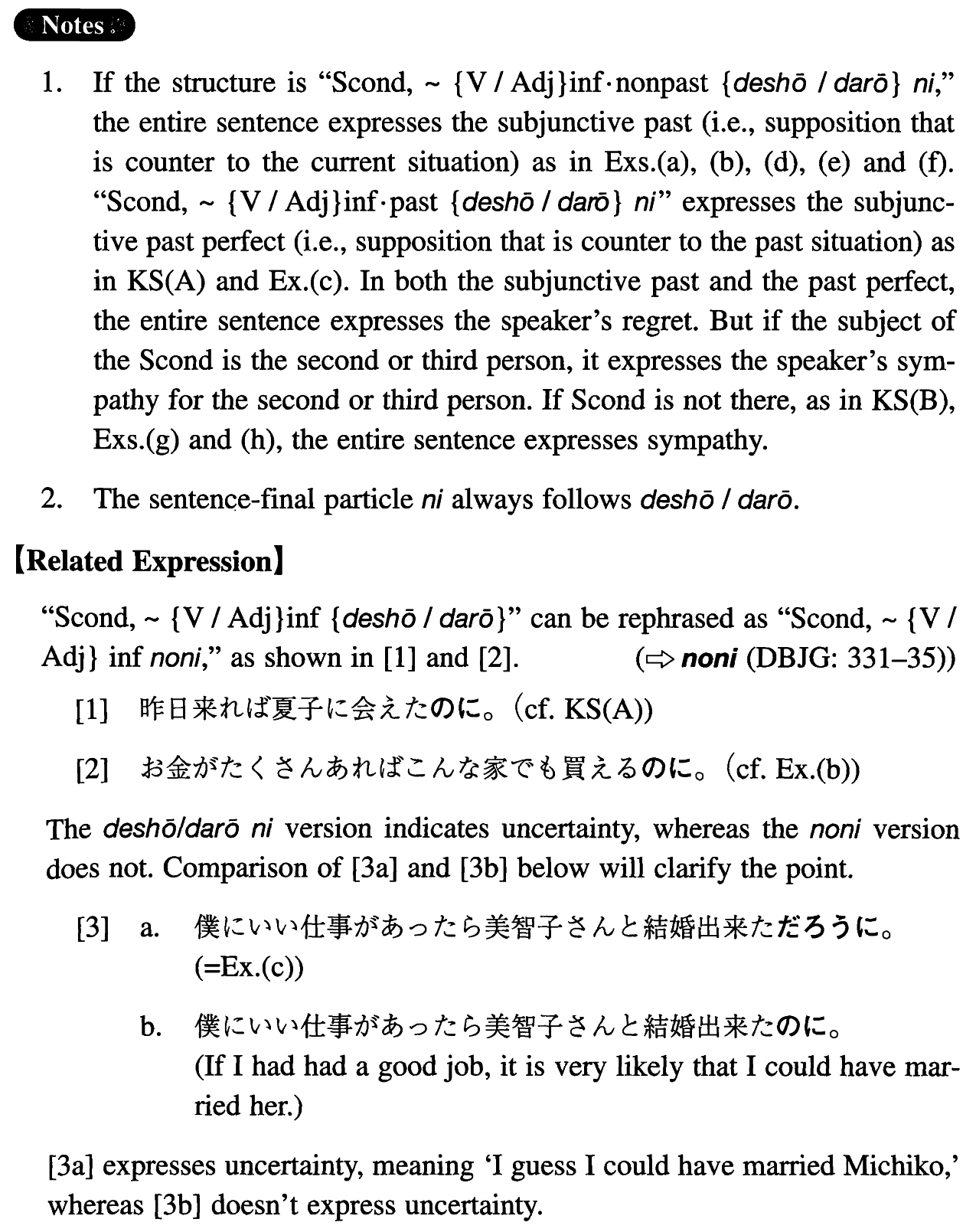
(ksa). 昨日来れば夏子に会えたでしょう・だろうに。
If you had come here yesterday, you could have met Natsuko.
(ksb). 老人が一人で暮らすのはさぞ寂しいでしょう・だろうに。
It must be lonely for an old man to live alone.
Formation
| (i){Verb/Adjective い}informal | {でしょう/だろう}に |
| {話す/話した}{でしょう/だろう}に | Would talk/would have talked |
| {高い/高かった}{でしょう/だろう}に | Would {be/have been} expensive |
| (ii){Adjective な stem/ Noun} | {Ø/だった} {でしょう/だろう}に |
| {静か/静かだった} {でしょう/だろう}に | Would {be/have been} quiet |
| いい{先生/先生だった} {でしょう/だろう}に | Would {be/have been} a good teacher |
Examples
(a). 後一年ぐらい日本にいたら日本語がもっと上手になるでしょうに。
If you could stay in Japan another year or so your Japanese would become more proficient.
(b). お金が沢山あればこんな家でも買えるでしょうに。
If we had a lot of money, we would be able to buy this sort of house.
(c). 僕にいい仕事があったら美智子さんと結婚出来ただろうに。
If I had had a good job I could have married Michiko.
(d). 飛行機で行けば簡単に行ける所でしょうに。
If you go by plane, you could easily get there.
(e). 彼はもう少し慎重に金を使えば、貯金出来るだろうに。
If he uses his money a little more carefully, he could save his money.
(f). 駅の近くのアパートに住んだら便利でしょうに。
If you lived in an apartment near the station, it would be convenient.
(g). 子供を二人も大学に行かせるのにはお金がかかるでしょうに。
It must cost a lot of money to send two children to college.
(h). 飛行機の切符をなくして、さぞ困ったことでしょうに。
You must have had a difficult time when you lost your airplane ticket.
Note image